The Auspicious Life of the Whites


The Auspicious Life of the Whites releases at the end of this month. To celebrate, I'm sharing the full first chapter here, free. Enjoy!
Chapter One: The Article
Deep Wealth, Deeper Roots
The White Family and the Long Arc of Black Freedom
By Dayona Harmon | The Carolina Standard, October 2009
Later syndicated in eleven publications including The Crisis and Emerge magazine. One of the most-read profiles in the Standard’s sixty-two year history.
The house isn’t what you expect.
You might imagine a gated entrance or a long driveway flanked by live oaks, or Bradford pears. Perhaps architecture that announces wealth when it chooses: columns, a Palladian portico, stone quarried from distant countries. Some might picture the grandeur of American opulence, a show of conquest and display.
What you find instead is a front porch.
Wide enough to host a church social, deep enough to hold a secret, furnished with the effortless grace of a woman who has never needed to prove anything to anyone. Rocking chairs lean gently in the shade. Potted herbs: rosemary and sage perfume the air. A pitcher of sweet tea filled with abundant lemon slices sweats prominently on a side table, already poured into two glasses, as if my arrival had been timed to the minute.
Mrs. Celestine White, Mama Cee to anyone who has earned the right (and, remarkably, a great many have) doesn’t rise as I climb her steps. She carries the posture of someone who stopped performing for strangers long ago. She is one hundred nine years old, though no public record confirms it; that number comes from my own private research, with her blessing to share it. She wears a cream-colored wrap embroidered in indigo at the collar.
Mrs. Celestine rested, her hands in her lap. Her eyes are the color of creek water when the sun strikes just right.
She looked at me for a moment before speaking my name in earnest. I make myself comfortable in the plush memory foam wicker rocking chair. I share my intention to take no more than about 45 minutes of her time, and ask permission to begin a voice recording of the interview. When I asked how many cities her family had started, Celestine White did not answer immediately.
“Cities,” she finally said, tasting the word. “My grandmother, my father’s mother, used to say that every time Black people find a way to be free together, somebody calls it by a smaller name. They call it a settlement. They call it a camp. They call it a commune, or a pocket, or a colony.” A pause. “We have preferred to call things what they are.”
So: cities.
In the United States, the White family has been the principal presence in three. She would name two of them, one on the West Coast, one on the East, both entirely Black, both prosperous, both invisible to the systems that would have otherwise catalogued them. The third, located in the Midwest, was something different: a mixed-race city ironically named Covert, a small Van Buren County township that integrated quietly and ahead of its time and refused to stop.
“We intentionally integrated Covert, through intention, resources, and people, Black and White, when they were awake and true to their own hearts.” She smiled “So we did.”
She would not give me exact locations, not yet. She noted that the existence of these cities was only recently made public, and only because a colleague of mine, a veteran journalist she referred to as “your friend Hayes”, stumbled onto something he could not ignore. “Hayes is a good man,” she said. “He asked us first. We respected that.”
There were other cities, she said. Not in this country. I asked where. She looked at me like a cartographer looks at someone who has just asked to hold the original map.
“Let’s stay with the ones you can get to by car,” she said.
To understand the cities, you have to understand the money and what came before. The public narrative tends to begin with the vineyards even though it began way before the vineyards.
Celestine White’s family, the Whites by their American name though she keeps another name, older and Arabic in origin, which she will not print in a newspaper, has been in the United States since 1797. The exact records were destroyed, by accident and partially by design. What is known, reconstructed through family oral history, ship manifests held in Lisbon, and the work of two genealogists commissioned in 1971, is this:
The progenitor was an Imam, the leader of a small but notable village in the Senegambian interior, a man of scholarship and standing. His name in the oral history is given as Ibrahima Coulibaly-Wite, the final name a regional honorific sometimes attached to men of spiritual distinction. In 1796, during the period when the Atlantic slave trade consumed the entire West African coast, he was taken.
What makes this story uncommon is that he wasn’t taken alone.
His wife, his three daughters, his four sons; all on the same ship.
This, by the logic of the trade, was an aberration. Slavers typically separated families, understanding that kinship was infrastructure, that love was a form of collective organization that could be weaponized against them. Celestine White’s theory is that the Imam’s captors understood exactly what they had and believed keeping the family together would make them easier to manage.
“They thought his authority over his own children would become their authority over him,” she said. “They was wrong.”
On the ship, Ibrahima Coulibaly-Wite reorganized. He could not free his family from the ship. But he could begin to build something even in defiance of the sickness and death of the ship’s interior. He spoke multiple languages. He prayed. He counseled. He made alliances with other captives who were not his kin by blood but who became his kin by covenant. By the time the ship made landfall in South Carolina, he had, in the estimation of the family oral history, organized roughly forty people into a loose confederacy of intention. They did not all survive the passage. But enough did.
“We were maroons,” Celestine said, with esteem. “Swamp folk. People who put our faith in secret refuge, born to the marshes, keeping our own counsel, trusting no one but the shadow and the water.”
The Great Dismal Swamp runs across the Virginia and North Carolina border and has been slowly giving up its secrets to archaeologists for the last three decades. It was one of the largest and most enduring maroon territories in North American history. At its height, it is estimated to have sheltered between two and ten thousand people who had escaped enslavement, people who built communities in the interior, developed sustainable economies, and raised children who had never been owned.
The White family, in its Coulibaly incarnation, was among them.
For roughly three generations, from the Imam’s arrival in the late 1790s to the years just before the Civil War, the family lived primarily in the swamp and adjacent territories, moving with the seasons and the pressures, maintaining knowledge that only belongs to people who have had to survive on it. They raided. That is the word Celestine uses, and she uses it without apology: they raided plantations, logging operations, supply roads, and the infrastructure of everything trying to kill them and those around them. They were in active collaboration with what would become the Underground Railroad.
“We were part of the sustaining of the Railroad,” she said. “We helped maintain it. We moved people. We fed people. We armed people.” A beat. “We protected people who needed protecting and removed obstacles that needed removing.”
I asked her to clarify what removing obstacles meant.
“I think you understood me the first time,” she said.
The vineyards came around 1859. The specific geography of the first vineyards is something Celestine declines to disclose entirely, except to say it was in a border state, on land purchased under a name that wasn’t the family’s American name, through an intermediary who was a free Black man of some standing and whose descendants are still in relationship with the family today.
The hemp came first, because hemp was practical and profitable and could be moved. The bees came shortly after, because, as Celestine tells it, “my great-great-grandmother had kept bees since before she could remember, and she said if she was going to build a new life, she was going to build it with something she loved.” The vineyards were the third element, the most audacious and the most legible to the white economy that would need to be interfaced with in order to grow.
“People ask how they hid it, how they protected it, how they kept it from being taken.” Celestine set down her tea glass. “That is the wrong question. The right question is what kind of people, after everything they had already survived, could build something like that? The answer is people who had been organized since before they touched American soil. People who had already spent years building an alternative to the world trying to destroy them. People who had the imam’s library. Yes, he brought books. Libraries of the mind. He memorized what he couldn’t carry. He taught his children and they taught their children. Organization, theology, law, mathematics. They knew how to build.” She paused. “They had been building the whole time.”
Ms. Celestine White has a personal net worth of $2.7 billion as of 2007. Fortune from family hemp, honey, and wine enterprises still thriving. Her wider family’s combined net worth is unknown.
On the question of Black wealth in a world that may resist it, Celestine White does not flinch.
“You’re asking if we’re afraid,” she said.
I asked if wealth insulates or targets.
“Both,” she said. “Always both. That has always been true for us and it has always been true for everyone.” She looked out toward the yard, where rosebushes were in a late season state of not quite finished. “The question should be less about the “target.” The question is whether you have built something worth protecting, and whether you have cared for people who know how to protect it.” She looked back at me. “We have had two hundred years of practice at building both.”
I asked whether the family worries about the current moment, about a country that is, even as we sit here in 2009, beginning to have public arguments about affirmative action, about reparations, about what Black wealth means in the American story.
“I think the country has always had those arguments,” she said. “Some of them were just conducted with fire.” She was quiet for a moment. “I don’t spend time being afraid of people who resent what we have. I spend time making sure we have built it right. Wealth is not a solution. Wealth is a tool. We have tried to use it like one.”
The reparations work and the lawsuit currently before the Supreme Court, White et al. v. United States, filed by the White family’s legal team in collaboration with a coalition of scholars, economists, and descendants’ organizations, is the reason this article exists.
The lawsuit argues that the federal government made specific and documentable promises to formerly enslaved people, including land and resources, the forty acres that became a punchline, and broke those promises in ways that are legally recoverable. It argues that the wealth gap between Black and white Americans is not an accident of culture or capacity but a direct result of documented government policies and failures, constituting ongoing and compounding injury. It argues, in its most ambitious section, that there is a legal mechanism by which this injury can be remedied, beyond symbolism and apology, landing in material transfer.
“People act like we are asking for something no one has ever done,” Celestine said. “We are not. The United States government has paid reparations before. To Japanese Americans interned during the war. To the Rosewood families. To others. The question is never whether the government can do it. The question is always whether they will decide that people deserve it.”
She said the family has been preparing this case for twenty-three years. Continuing the freedom work of her ancestors in the swamp. When State and Federal reparations efforts stalled, the White family went straight to the Supreme Court on behalf of all Black Americans. She said the legal team alone involves forty-seven attorneys across nine states. She said the evidentiary record is, in her words, “the most thorough accounting of American theft ever assembled in one place.”
I asked her what winning looks like. She was quiet longer than she had been quiet about anything else.
“Winning,” she said finally, “looks like your grandchildren’s grandchildren not having to have this conversation.” She picked up her tea glass. “But we’ll start with the redress of fourteen trillion dollars.”
The recorder had been off for forty minutes.
They had moved from the front porch to the interior of the home.
A magazine sat open on a coffee table, and Celestine White had not moved from her chair. The photographer had left an hour ago. Dayona was still in the wingback chair across from her, but she had closed her notebook, making the next thing that happened off the record.
Dayona was looking at the second page of the spread, at the photograph of the swamp, a wide shot, cypress trees and black water, light coming down through the canopy at that angle it only reaches in late afternoon. It was a beautiful photograph. It told almost nothing.
“How many is it really?” she asked. “The cities.”
Celestine looked at her.
“You published three,” she said. “Your colleague Hayes found three, and you confirmed three.” She paused. “But I’ve been doing this for twenty years, and I know when someone is answering a smaller version of the question I asked.”
The afternoon light was doing what it does through the tall windows of the room, falling across the hardwood in long rectangles, warming the spines of the books along the east wall. There was a sound from somewhere deeper in the house, a grandchild probably. Maybe two.
“Hayes found three,” Celestine said.
Dayona waited.
“There are eleven,” she said. “That we claim. There are others we have relationships with that we do not claim, because they were not ours to start and they are not ours to name.” She set down the magazine and straightened it on the table with two fingers. “Seven outside the United States. Haiti. Trinidad. Two in Ghana. One in Senegal, which is the one that matters most to me for reasons you can guess. One in Brazil.” She paused. “And one in a place I’m not going to tell you yet, because it’s not finished.”
Dayona was quiet for a long moment.
“Mrs. White,” she said, “I don’t think I wrote the right article.”
“You wrote the right article,” she said. “For now.” She stood slowly, the way she did everything, with the unhurried authority of someone who was not performing effort, and moved toward the hallway. “Come back in five years,” she said over her shoulder. “Or send someone good.”
Three miles away, in a newer part of Charlotte, a young man named Marcus White was asleep in a condo that still smelled like fresh paint when the knocking began. It was the kind of knocking that knew you were home. He lay still for a moment, listening, cataloguing the quality of the sound the way his great aunt had taught him to catalogue everything, without fear and full attention. Then he got up, went to the door, and opened it to a woman he had never seen before, wearing around her neck a pendant he had seen before, in a photograph his great aunt kept in a drawer she had never explained.
The woman looked at him for a moment and said a single sentence in a language that was not English but that Marcus felt energetically. Something shifted in him. He stepped back to let her in.
The cities began as a response to watching what happens when Black people build in plain sight.
Celestine White was taught this history by the elders in her family who had lived it. They had lived through Reconstruction, old enough to understand what was being offered and old enough to watch it be taken back. They saw Black men elected to office and then removed from it. They saw land titles honored and then contested and then stolen through mechanisms that wore the clothes of law. They watched the burning of a town called Edgewood that their family had created. They watched the burning from a distance that was not distant enough. Before that they had watched six other organized massacres that the country would later agree to call riots, because riot implies accident and accident implies no one is responsible.
“They used to say,” Celestine tells me, “that the lesson of Reconstruction was that we had built where they could find it.”
What came after was an architectural decision. If visibility was the vulnerability, then the work going forward would happen at a different depth, below the survey line, below the census, below the threshold of what the country could see and destroy. The cities were hidden because the family had paid attention. Continuing in the wisdom of what generations had learned in the swamps.
Dayona had been told to take the exit for a town she had never heard of, drive twelve minutes east, and look for a water tower painted the color of persimmons.
Dayona had been a journalist for twenty-three years. She had reported from Sarajevo in 1994. She had sat in the waiting rooms of senators and the kitchens of sharecroppers. She was not, by any reasonable measure, a woman who was easily surprised. She would think about this later, would think about it for years, as a way of measuring what it meant that when she crested the ridge on the county road and the city came into view below her, she pulled over and sat with the engine running for a full four minutes before she could make herself drive down.
It was not the size of it, though the size of it was staggering. Almost half a million people lived there. She knew this number from the briefing documents Celestine White’s team had sent her, had read it several times, had nodded at it the way you nod at a figure that means nothing until it becomes visible. Now it was geography. A skyline that curved. Buildings that rose in shapes that emerged from and into the landscape. No two buildings were the same height. No straight lines where a curve would do. The city appeared to rest in the landscape as part of it.
She drove down.
The woman assigned to accompany her was named Sade. She offered no last name and Dayona did not push. She had the manner of someone who had shown people this place before and had learned to let the place do the talking. She drove in a vehicle Dayona did not recognize, something electric and low to the ground, and said almost nothing for the first twenty minutes.
The streets were wide and unhurried. That was the first thing Dayona noticed, then the architecture, then the cleanliness, then the extraordinary mural that covered an entire city block depicting something she could not fully parse on first pass, a kind of history rendered in ochre and deep green figures. What Dayona noticed first was that no one was rushing. Children moved in large groups and walked in clusters with other adults. An older man was sitting on a bench at a wide intersection doing nothing at all, just sitting, watching, present.
“Is that a park?” Dayona asked, pointing to a long stretch of green that ribboned between two rows of buildings, terrace stacked above terrace, plants climbing the outer walls in thick architectural ropes of green, flowering things she could not name.
“That’s Seventh,” Sade said. “It runs the whole central district. About two miles.”
Dayona looked at the terraces. Each level was distinct. Some were clearly communal, people gathered around tables, around what looked like outdoor kitchens. Others were private, screened with living walls, intimate. The growing was everywhere. Herbs in window boxes. Fruit trees espaliered against south-facing walls. What appeared to be a working apiary on the roof of a four-story building, the hive boxes arranged with the seriousness of a formal installation. Dayona thought of Celestine’s great-great-grandmother.
Fashion was the second thing, or rather the third, because the second thing was the absence of a thing. Dayona realized, after twenty minutes of driving, that she had not seen a single advertisement. No billboards. No bus placards. No branded storefronts fighting each other for visual attention. The surfaces of this city were either functional or beautiful, and a remarkable number of them were both, and none of them were trying to sell her anything. The effect was refreshing in a way she could not immediately name.
Against those clean surfaces, the people were extraordinary.
The clothing was beautiful and meticulous. An elderly woman passed in a coat constructed from at least four different textiles, deep violet wool, softened yellow leather, a muted tartan, and a strip of indigo denim, each panel earning its place, the whole thing moving like weather. Two young men sat outside a café in silhouettes that managed to be both architectural and effortless. A teenager, maybe fifteen, was wearing embroidery running from collar to hem in a single continuous field of threadwork, burnt orange, cobalt, and gold stitching blooming across a pale ivory base.
“Is there a design school here?” Dayona asked.
“There are four,” Sade said. “Two for adults. Two that start at age seven.”
“We found that waiting until people are older tends to imply that creativity is a special thing. We don’t think it is. We think it’s a basic thing. Like eating, sleeping. Like building.”
They almost passed by the clinic unnoticed. It occupied a long low building set back from the street behind what appeared to be a garden that was doing double duty as a waiting room. People sat there easefully. An older woman was reading. Two children were asleep on a bench with their heads in a woman’s lap, and she was asleep too, lightly, undisturbed and unworried.
“Full coverage,” Sade said. “Every resident. Dental, vision, mental health, preventive.”
Much later, after the sun had moved and the garden terraces had come alive with evening lights, after she had eaten food that had changed her life, after she had watched a performance in an open square that left her with a lifted spirit and a full heart, Sade drove her back toward the persimmon water tower and the county road and whatever the rest of the world was doing.
“Why now?” she asked. “Why let someone see this now?”
Sade drove for a moment without answering.
“Mrs. White is continuing to age,” she said finally. “There are things she wants documented while she can still be the one to say what they mean.” She turned onto the county road. The city disappeared behind the ridge line as if it had never been there, as if the land had simply closed over it. “And,” she added more quietly, “there are forces that will try to tell this story wrong. We would rather tell it first.”
Dayona looked back over her shoulder at the ridge. Nothing. Just tree line and late sky and the silence of a country road that didn’t readily tell what it was hiding.
Dayona turned back around and opened her notebook and began, for the second time in her career, to wonder if she was writing the right article.
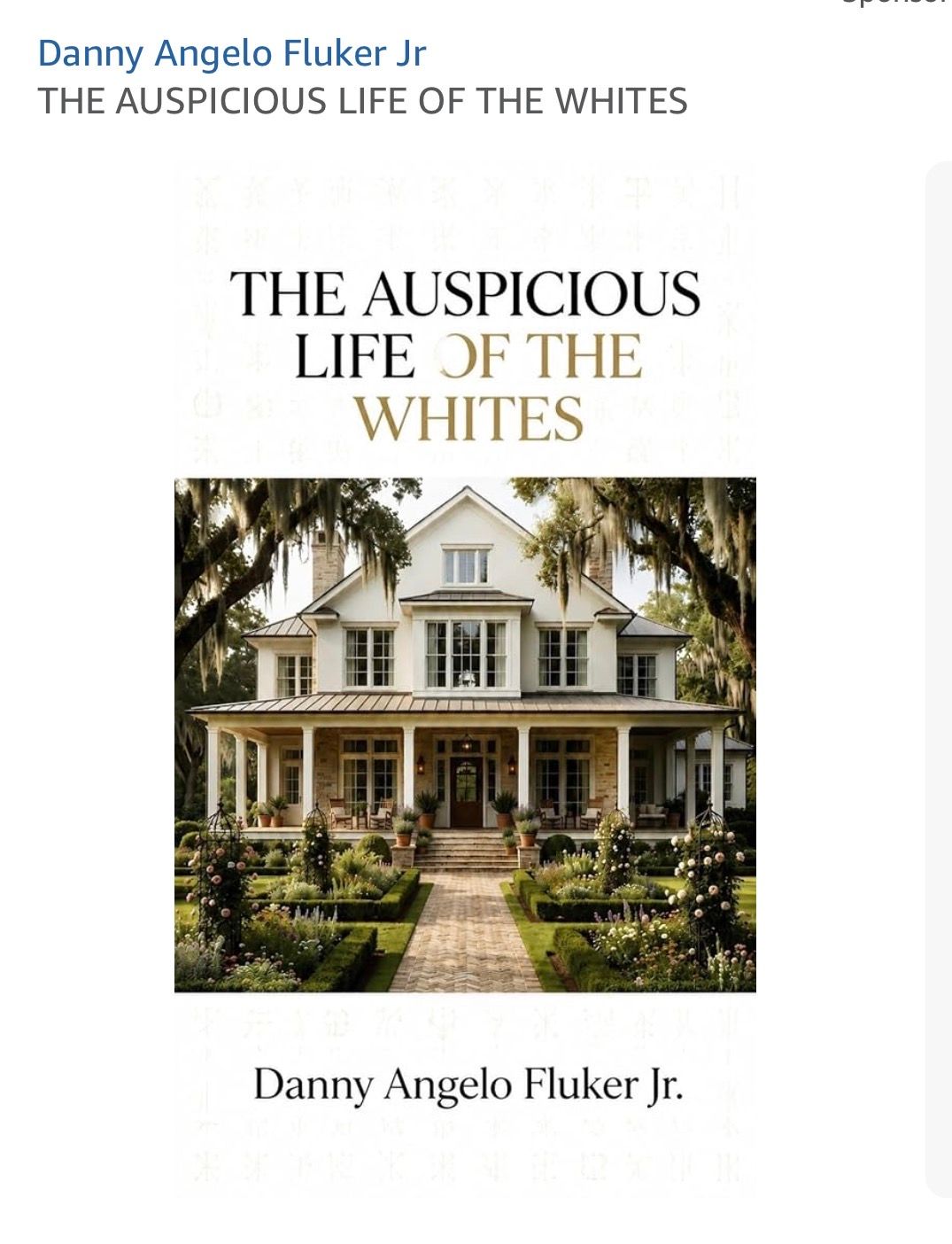
I hope it pulled you in. If you’re ready to keep going, you can pre-order the digital edition here, it also helps the book’s ranking on Amazon; or order a physical copy directly from me here.
The book will be available June 30th.
If you’d like to support bringing this story to Audible and eventually to film, consider contributing to the fundraiser here.
Thank you for being here from the beginning.